
Signal of the week: Bears have been paying an average of 11% interest in April to hold their bets against Bitcoin, briefly hitting 19%, the highest rate since January 2023. That came to an unprecedented over $4 million in daily premiums. Despite that cost, they keep doubling down.
Long-term holders just made one of the largest single-week accumulation moves in Bitcoin’s history. At the same time, short sellers are paying a record price to bet against this accumulation. One of these two groups is about to be proven very wrong, potentially leading to a massive price action.
About the Bitcoin Impact Index
The Bitcoin Impact Index measures which groups of Bitcoin holders are under financial stress, how severe that stress is, and whether it’s severe enough to shake confidence in the market’s direction. It combines on-chain holder behaviour, ETF and derivatives activity, and exchange-level liquidity flows into a single weekly score between 0 and 100. Unlike sentiment indicators, it deliberately excludes social media and volume data to focus on what participants are doing rather than what they are saying.
Score bands:
- Normal Rotation (0–24) — routine profit-taking, no structural shift
- Elevated Repositioning (25–49) — specific groups shifting positions, pressure uneven across the market
- High Impact (50–74) — broad stress across multiple holder groups and institutional flows simultaneously
- Critical Impact (75–100) — full capitulation: LTH losses, large ETF outflows, major liquidations, and heavy exchange inflows at once
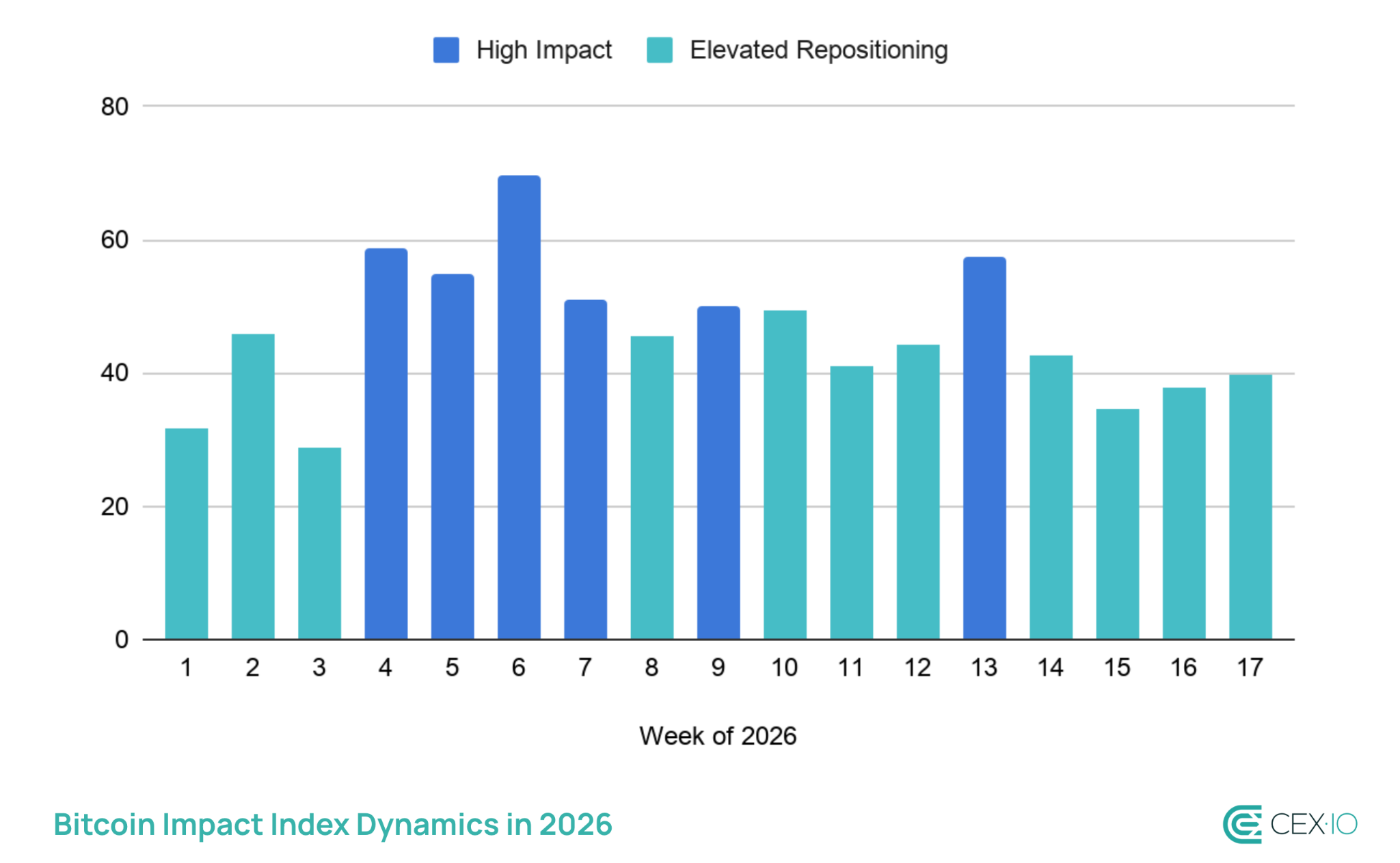
Week 17 (April 19–25): BII 39.6 — Elevated Repositioning
The index nudged up slightly from last week, staying firmly in Elevated Repositioning. The headline number suggests relative calm. The data underneath is anything but.
Positive signals: long-term holders went on a historic buying spree
Long-term holders reportedly added close to 800,000 BTC in a single week. Their 30-day accumulation now stands at approximately 1.23 million BTC, one of the largest monthly accumulation figures ever recorded. Long-term holders now control around 80% of all Bitcoin in existence, the highest share since July 2025.
This group buying so aggressively matters for one reason: they are the ones who historically get the direction right over longer timeframes. LTH SOPR also briefly recovered above 1, meaning long-term holders who did sell this week did so primarily at a profit.
Moreover, the share of LTH supply in profit declined to 66%, the lowest since January 2023. That might sound bad, but in context it means long-term holders are accumulating while their existing holdings could be underwater — a pattern more consistent with deliberate bottom-building than with capitulation.
As such, net unrealized profit/loss (NUPL) improved close to 0.3, its best level in months. The broad picture of patient, large-scale capital entering the market has now been consistent for several weeks.
Negative signals: short sellers are digging in deeper
Here is the contradiction. While long-term holders buy at one of the fastest rates in history, short sellers are paying extraordinary amounts to maintain the opposite bet. Despite price recovery, funding rates hit a new three-year low. In April alone, bears paid an average of 11% interest to stay short, with rates briefly spiking to 19%, levels not seen since January 2023.
At those rates, short sellers were collectively paying over $4 million every day just for the right to stay positioned against Bitcoin, as per Checkonchain data. That level of conviction and that level of cost is unprecedented, even compared to previous bear markets. Bears believe so much that a significant drop is coming that they are willing to pay heavily for that belief.
Aside from that, realized loss density — how much loss is being concentrated per unit of Bitcoin actually moved — jumped to 40%, suggesting deeper losses for recent holders. The short-term holder picture also softened slightly, with their profitability declining from last week’s level.
Mixed signals: the squeeze is already happening — but it hasn’t broken anything yet
Short liquidations made up 77% of total liquidations this week, indicating that a short squeeze is in progress and the recent price increase was largely driven by these forced short closures.
The important context is that there are still many short positions remaining. Bears who got squeezed out this week have been replaced by new shorts doubling down at higher prices, as the funding rate confirms. This means the squeeze potential has not been exhausted — there is still a significant pool of short positions that would need to be closed if price continues higher, which could amplify an upward move.
However, such a high level of bear conviction could also lead to a rapid trend change if bullish momentum fades away and fails to sustain above major resistance levels such as $80,000.
What could happen next
The tension between these two forces — historic accumulation on one side, historic short conviction on the other — cannot persist indefinitely. The resolution tends to be fast and decisive when it comes.
If price breaks above $80,000, it would be a real test for bulls as short-term holders will be in profit on average for the first time since October 2025, and some might use this opportunity for profit-taking. In January 2026, when price briefly touched STH cost basis, it turned out to be a local high before a February selloff. However, if the price breaks and sustains above $80,000, the remaining shorts could face mounting losses and will be forced to close positions, adding fuel to the move.
One way or another, given the scale of LTH accumulation, a genuine break lower would require something significant to shake conviction that has been building for three months straight. The index is likely to stay in the upper half of Elevated Repositioning until this resolves. When it does, a sharp move in either direction will likely occur.
The web content provided by CEX.IO is for educational purposes only. The information and tools provided neither are, nor should be construed as, an offer, or a solicitation of an offer, or a recommendation, to buy, sell or hold any digital asset or to open a particular account or engage in any specific investment strategy. Digital asset markets are highly volatile and can lead to loss of funds.
The availability of the products, features, and services on the CEX.IO platform is subject to jurisdictional limitations. To understand what products and services are available in your region, please see our list of supported countries and territories. This page includes additional links to information about individual products, and their accessibility.