
- Bitcoin’s liquidity is deteriorating fast, with realized cap signaling a severe slowdown in fresh capital inflows.
- Long-term holders experienced the largest Bitcoin distribution since 2018, with wallets holding BTC for 1-2 years and 3-5 years showing fueling record asset selling.
- Stablecoin behavior reveals a demand problem, not a supply problem as exchange reserves hit an all-time high but refuse to deploy.
- Order books are thinning at the fastest pace this year, with global 2% market depth dropping 25%.
Bitcoin’s price saw an over 25% dip since an all-time high in early October, and this pullback might seem like a standard cooldown. However, beneath that surface, liquidity is thinning, demand is fading, and capital is quietly exiting the ecosystem. The issue is market structure weakened in ways that historically preceded deeper corrections, but what are the chances for this to happen?
This report examines Bitcoin’s liquidity landscape to explain why Bitcoin’s “normal correction” may be masking a much deeper liquidity problem.
Realized Cap: Collapse That Makes This Correction Look Different
Over the past two months, Realized Cap’s 30-day change crashed from +$38 billion to just +$4.7 billion, a 88% collapse in fresh capital. Realized Cap values each coin based on its last on-chain movement, offering a cleaner view of true economic inflows than market cap.
This drop is a sharp contrast to earlier phases of the 2024-2025 bull trend:
- In Q1 2024, Bitcoin absorbed $50 billion long-term holder (LTH) distribution by attracting $80 billion in new realized value.
- In Q4 2024, $75 billion in LTH selling and transaction activity took place alongside a $90 billion increase in the realized cap.
- In July 2025, $40 billion in LTH transaction volume accompanied a $65 billion net change in realized cap.
As a result, the largest spikes in LTH profit-taking and activity occurred when Bitcoin was within an uptrend. This limited Bitcoin’s upside momentum, but it didn’t stop the price from updating all-time highs. During correction periods, LTH activity decreased and they transitioned to asset accumulation. That’s the distribution into strength.
- This time, the dynamics flipped, LTHs distributed nearly $100 billion in value, while realized cap fell. Hence, demand failed to keep up with old supply, and more capital is leaving the market than entering it. That’s the distribution into weakness.
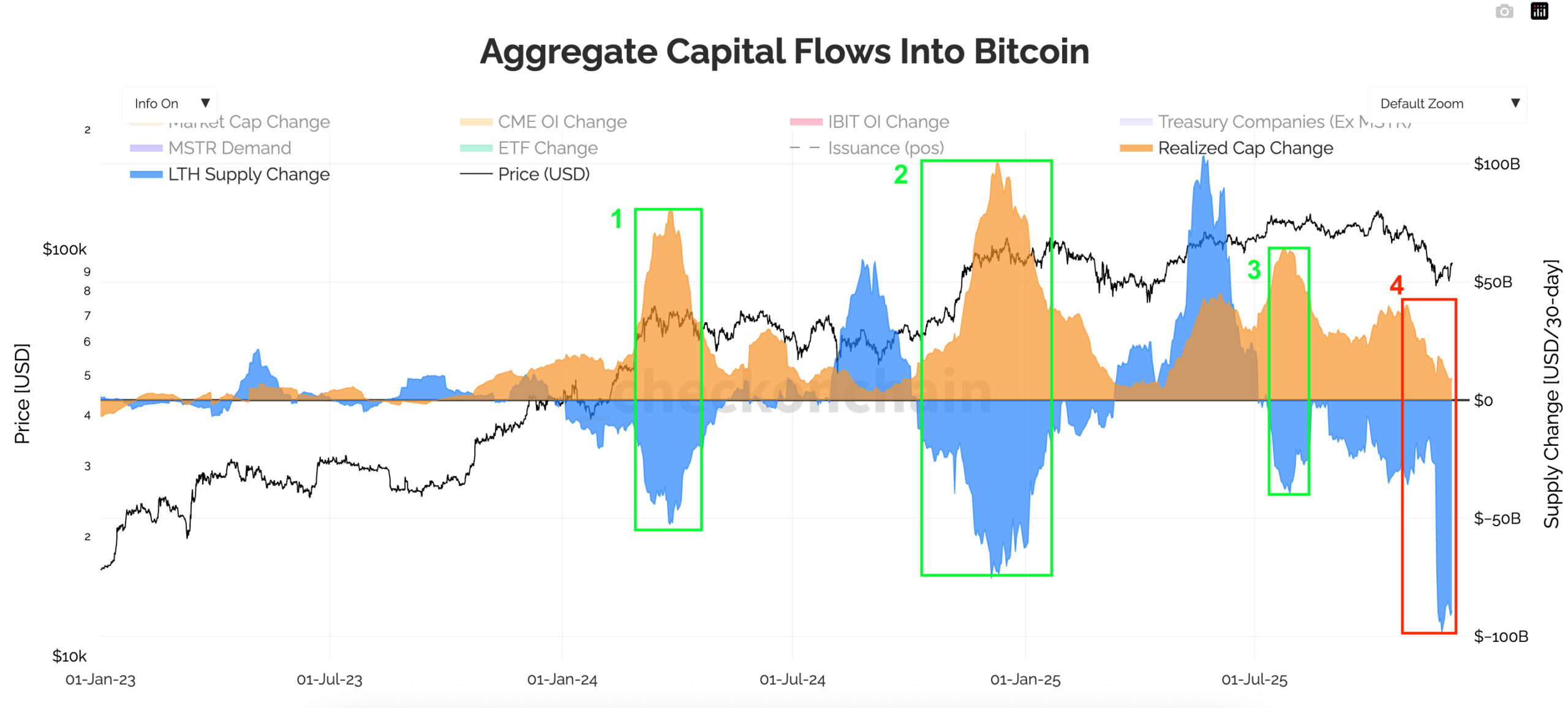
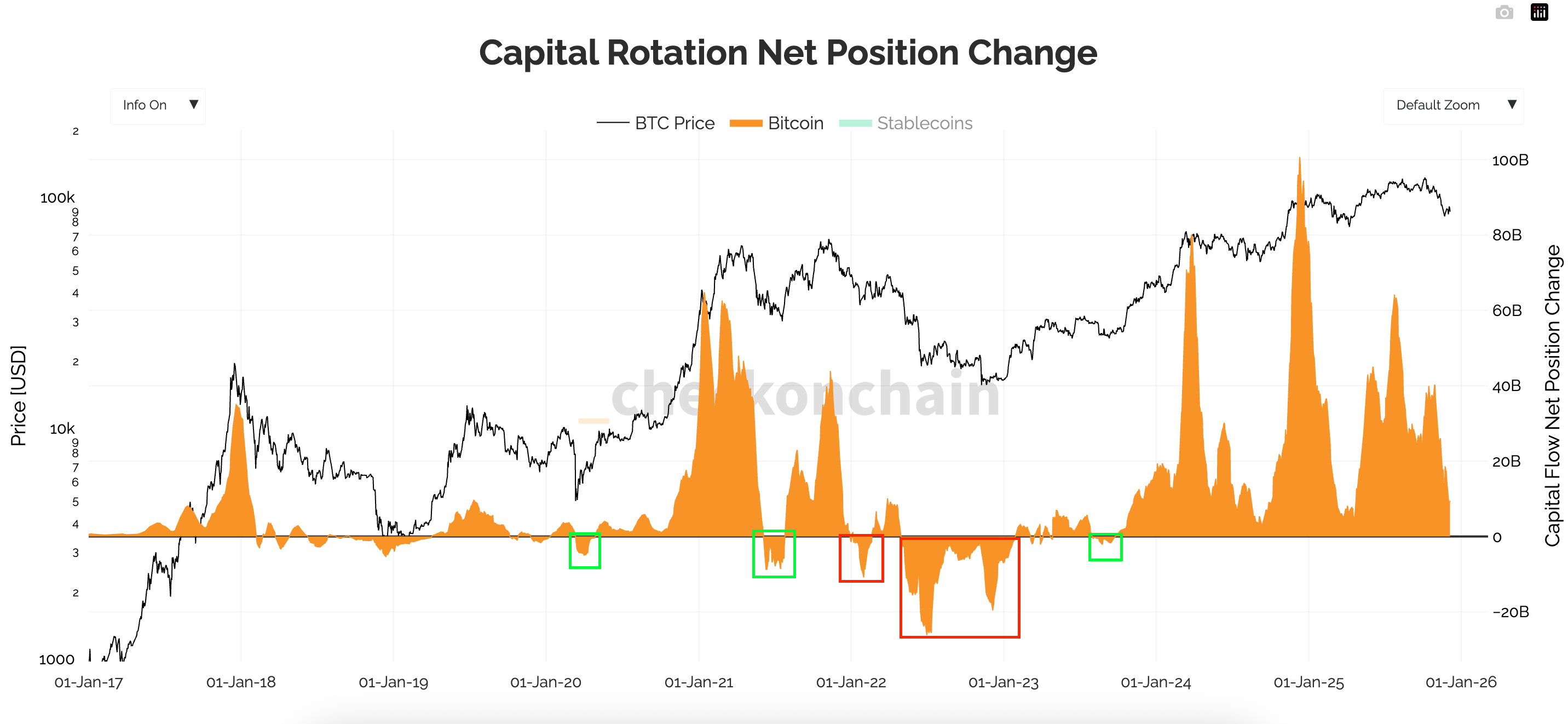
If the 30-day realized cap turns negative, the market could flush out weak hands even further, potentially leading to a deeper correction. Back in January 2022, this coincided with the beginning of a prolonged bear market.
Long-Term Holders: The Largest Asset Distribution Since 2018
Over the past two months, LTH supply dropped from 15.3 million BTC to 14.1 million BTC, experiencing a distribution of 1.2 million coins. The LTH share of total supply declined from 77% to 71%. This is the largest distribution in LTH supply since December 2018, a period when Bitcoin lost almost half of its value.
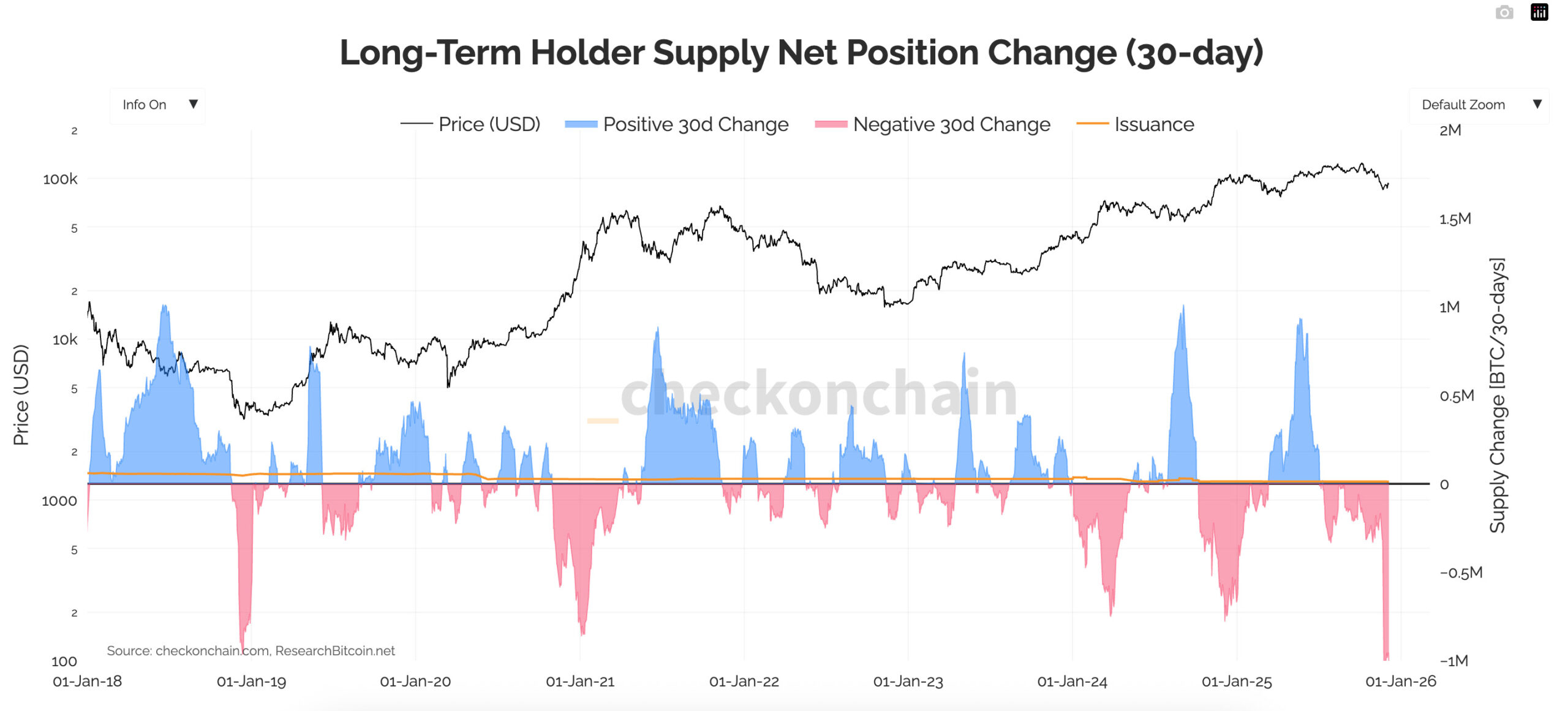
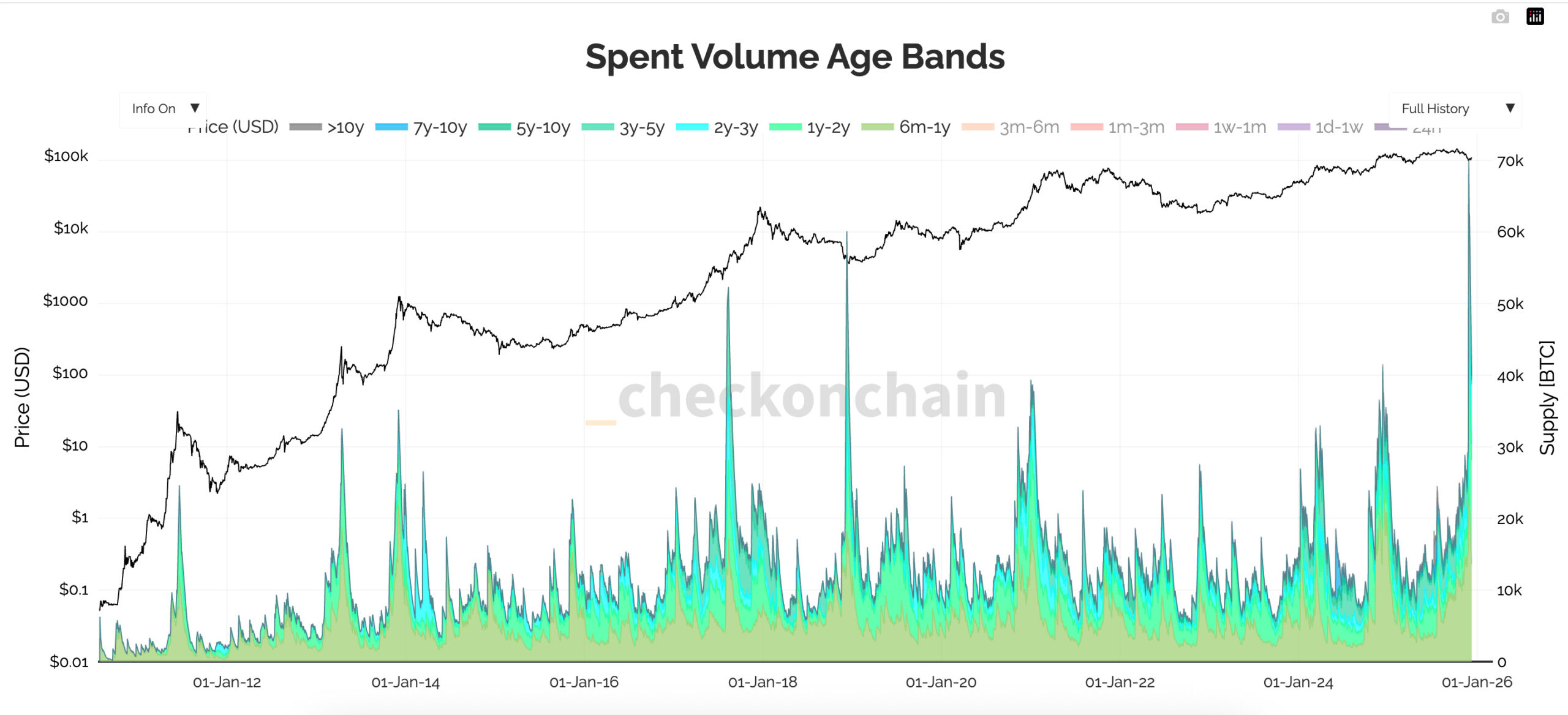
A significant portion of this distribution was actually selling coins, not just moving them to other wallets. For instance, Spent Volume Age Bands suggests that long-term holders recently recorded their largest selling event ever, increasing downside risk and market exhaustion. The biggest spike in LTH selling activity was fueled by wallets that held Bitcoin for 1-2 years and 3-5 years.
Short-Term Holders: Underwater and Vulnerable
Short-term holders (STH) are often the most reactive in downturns. Their average cost basis currently sits around $103,500, while the spot price hovers roughly 10% below that. Although such a drawdown might not sound extreme, it was enough to intensify asset selling.
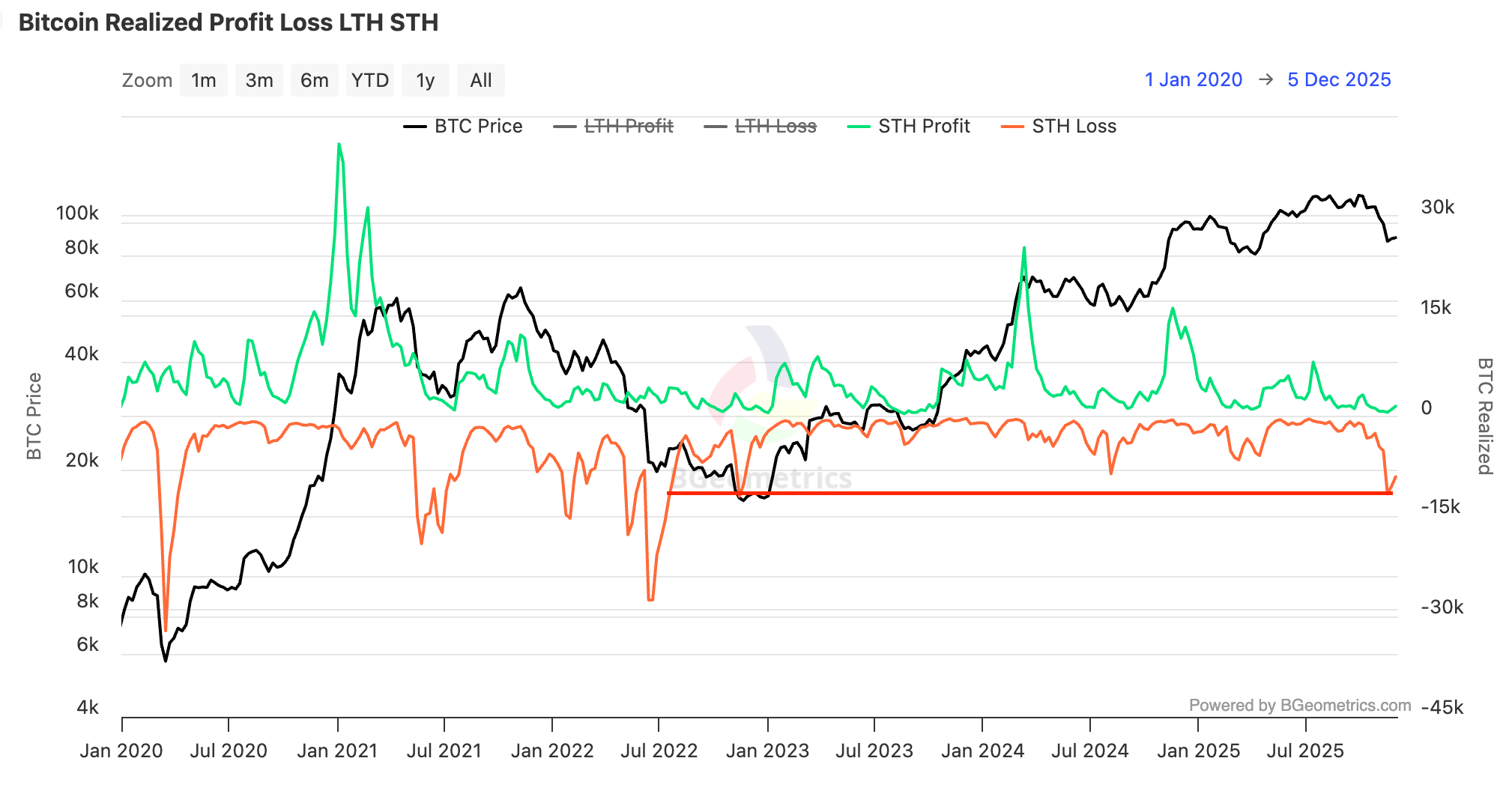
STH MVRV, which measures whether short-term holders are in profit or loss, plummeted to its lowest level since 2022, indicating that recent buyers are now deeply underwater.
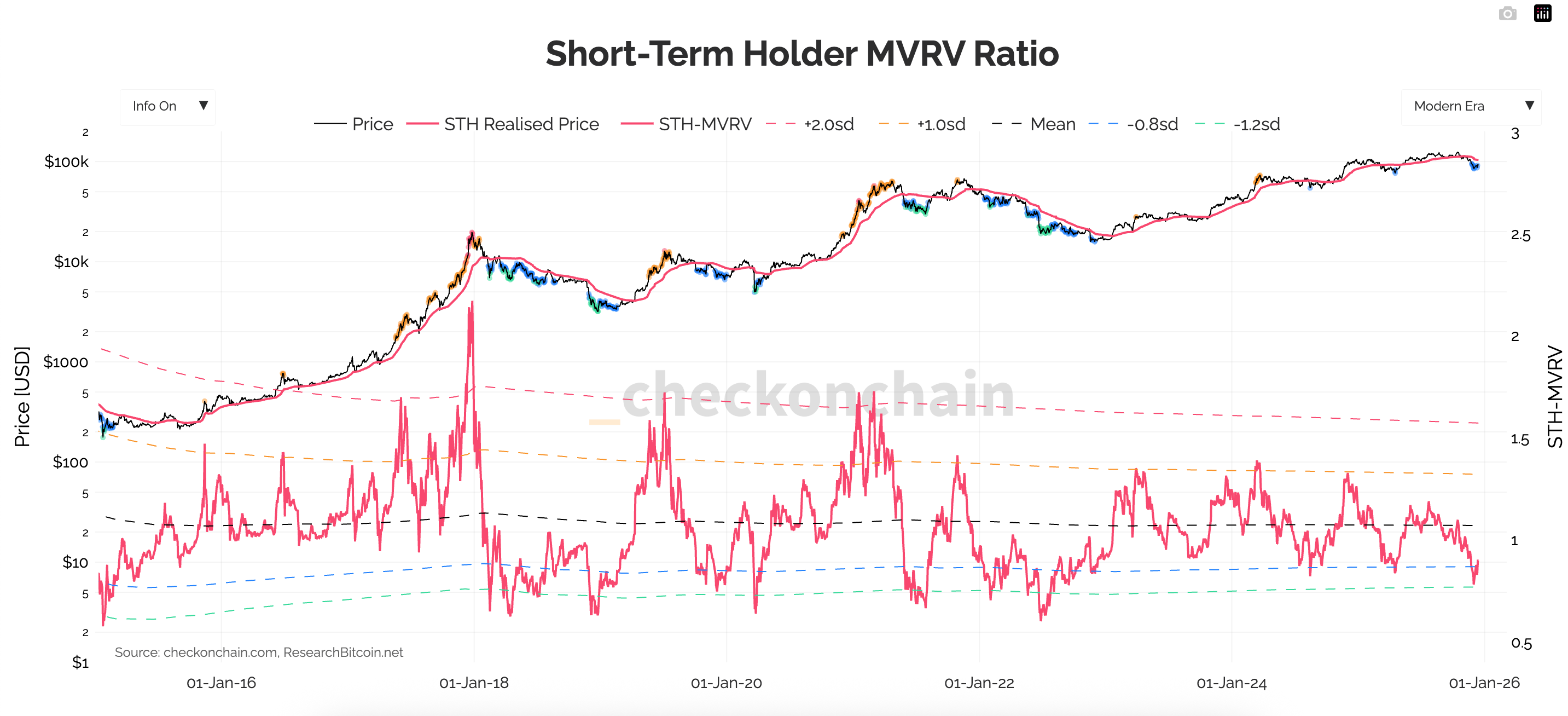
More tellingly, short-term holders’ realized losses have reached their highest point since 2022, indicating that these investors are actively selling with losses rather than holding through the volatility. With Realized Profit/Loss Ratio near 0.2, buy-side liquidity essentially evaporated, leaving the market vulnerable to increased volatility as concentrated selling meets minimal demand.
Stablecoins: The Dry Powder That Don’t Deploy
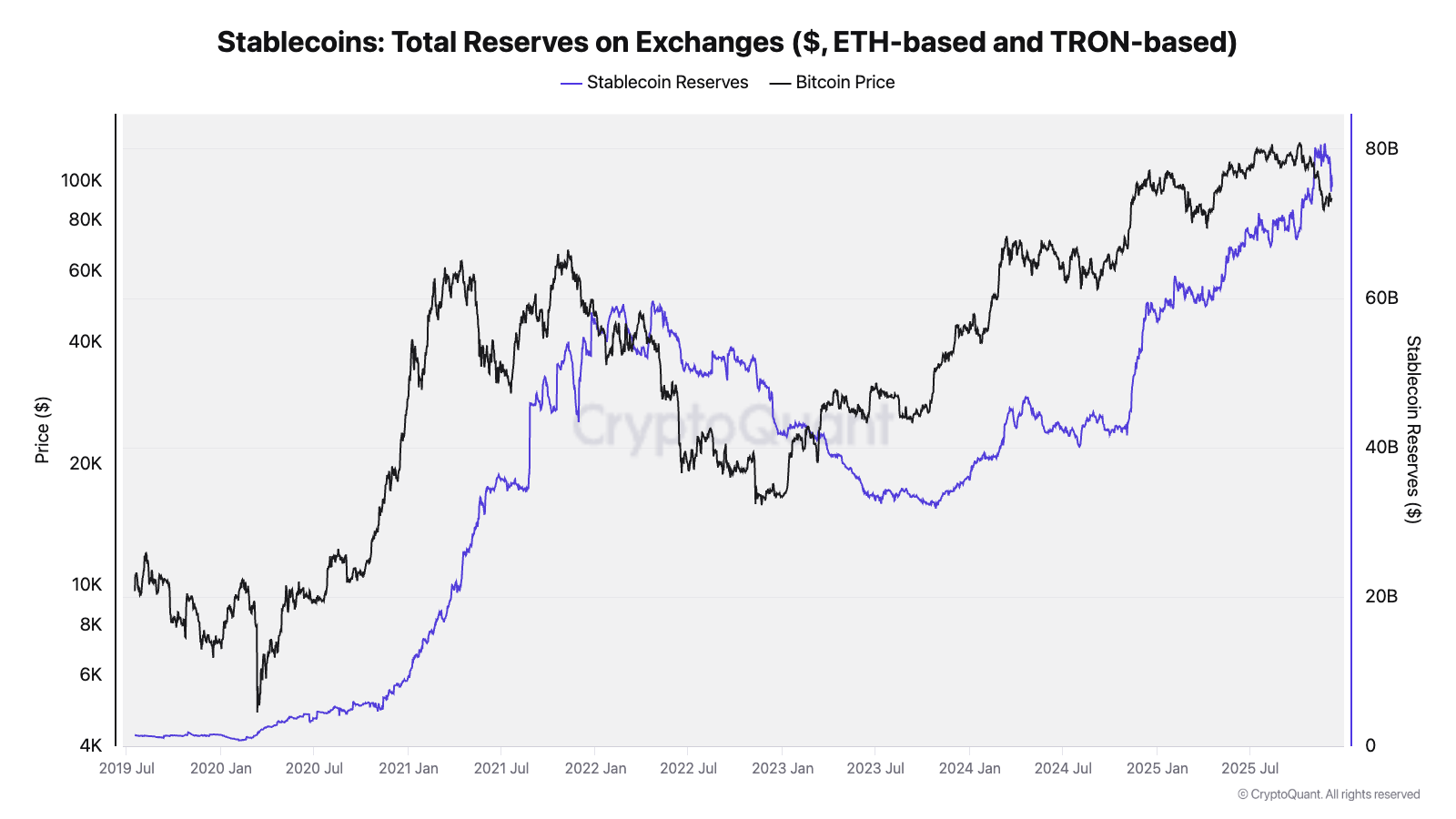
Perhaps the most perplexing aspect of Bitcoin’s correction is the behavior of stablecoins. Over the past two months, total stablecoin supply remained essentially flat near $300 billion, briefly moving down in November.
At the same time, stablecoin reserves on exchanges continued updating all-time highs, recently reaching $80 billion, and showing 15% increase since early October. So this isn’t a story of absent capital, but about present capital refusing to deploy to support Bitcoin’s price.
This creates two possible explanations:
- Lack of conviction — the dry powder exists but holders are waiting for lower prices.
- A velocity problem — the same capital is recycling without new fiat entering the crypto ecosystem.
It’s most likely both to a certain degree. This stablecoin behavior directly explains why Realized Cap is declining. During bull runs, new fiat converts to stablecoins, which then purchases Bitcoin, driving Realized Cap higher. Currently, stablecoin supply is stagnant, so any Bitcoin purchases come from recycled capital entering at lower prices than previous sellers exited. So the market might be cannibalizing itself rather than attracting fresh capital.
Market Depth: More Chances For Rapid Swings
Order book analysis reveals another layer of fragility. The 2% market depth across the top 30 exchanges, measuring how much Bitcoin can be traded within 2% of the current price, has declined 25% over the past two months. This is the largest market depth drop in 2025.
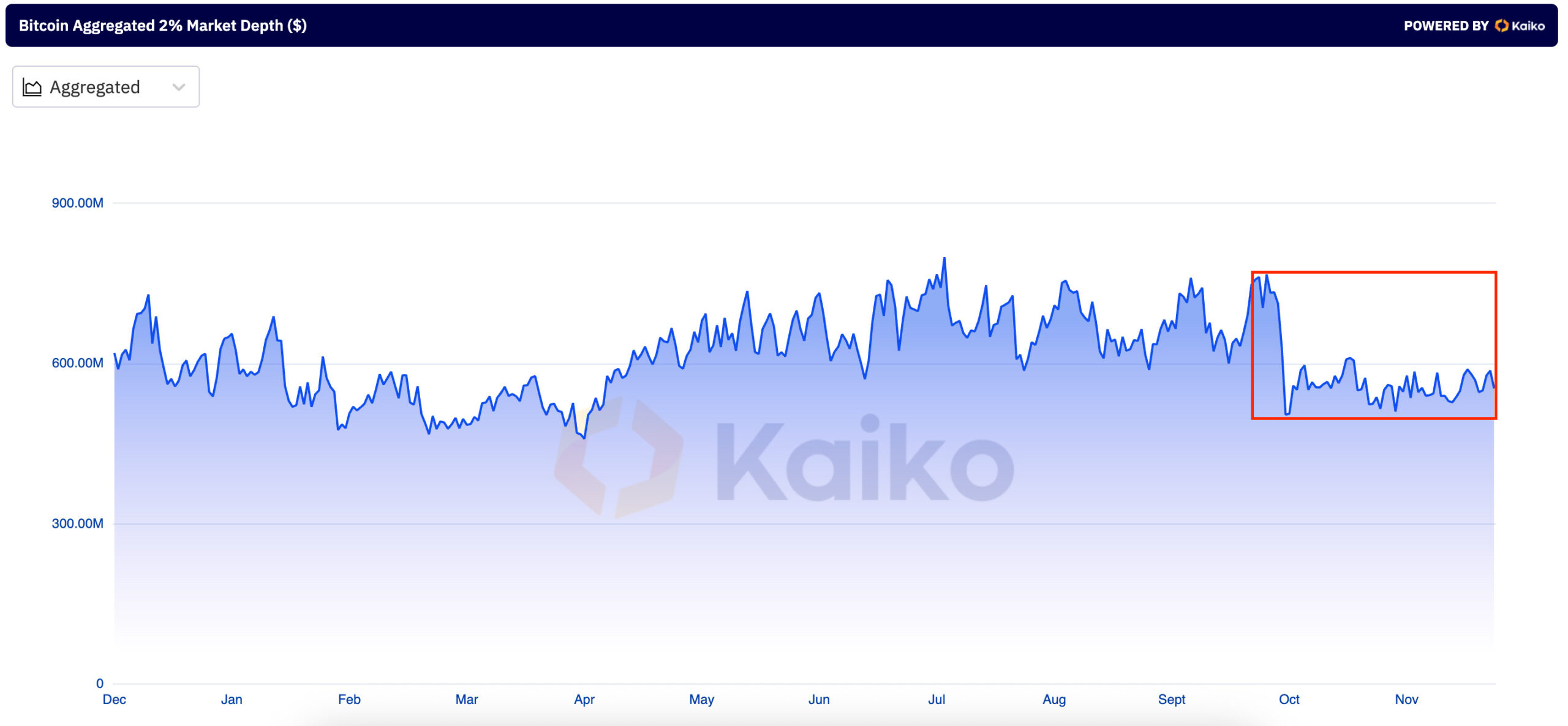
This thinning liquidity creates a double-edged sword. If demand returns, order books with 25% less depth could trigger more explosive upside moves. However, downside risk is equally amplified. If panic selling returns, the price could quickly gap to $81,000 and other major resistance levels.
Three Paths Forward
Consolidation (40% probability)
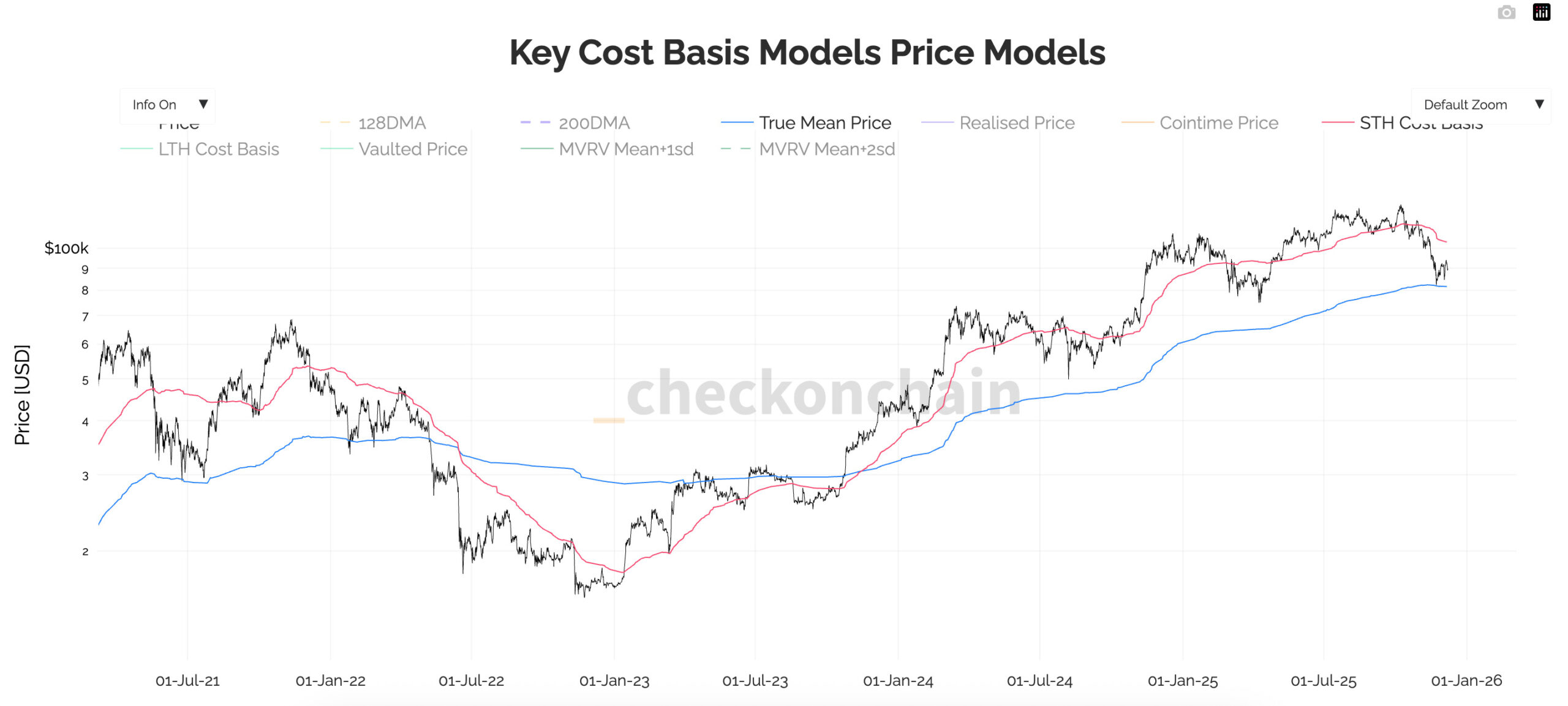
It involves Bitcoin ranging between a true mean (now at $81,000, blue line) and a short-term holder cost basis (now at $103,500, red line) over the next 2-3 months.
The 30-day Realized Cap may stay positive, but don’t show significant growth. Stablecoin supply may remain flat, or experience modest changes. Short-term holders could become exhausted and decrease their selling at a loss, while long-term holders may temporarily scale back profit-taking.
The existing data already supports this scenario, with multiple above-mentioned indicators recently registering modest recoveries from highlighted extreme figures. But these recoveries are currently not sufficient enough to claim a trend reversal.
Resolution from consolidation could break either direction. In mid-2021, the breakout above STH cost basis pushed Bitcoin to a new all-time high. In H1 2022, a failed breakout above STH cost basis and subsequent drop below true mean led to a deeper bear market.
Capitulation (35% probability)
It could trigger if the 30-day Realized Cap turns negative and the price drops below true mean (now at $81,000) in the next 6-8 weeks. This could reinforce the further profit-taking among both long-term holders and short-term holders, or even lead to increased ETF outflows and Bitcoin selling among certain DATs.
Historically, negative Realized Cap periods could also mark local bottoms (green rectangles), suggesting that capitulation can be temporary. However, if Realized Cap fails to strongly rebound to positive values (red rectangles), this could signal a potential bearish dominance.
Bullish Scenario (25% probability)
It could happen if the 30-day Realized Cap rebounds above previous top at $40 billion, and the price breaks above the short term holder cost basis (now, at $103,500) in the next 6-8 weeks.
Thinner liquidity and market depth can act as a setup for a potential explosive upside. However, this would require a significant bullish catalyst. Global liquidity no longer shows positive correlation with BTC, and the macro environment currently paints a more cautious picture, with Japan’s potential rate hike increasing risk aversion, so it may take time for it to appear.
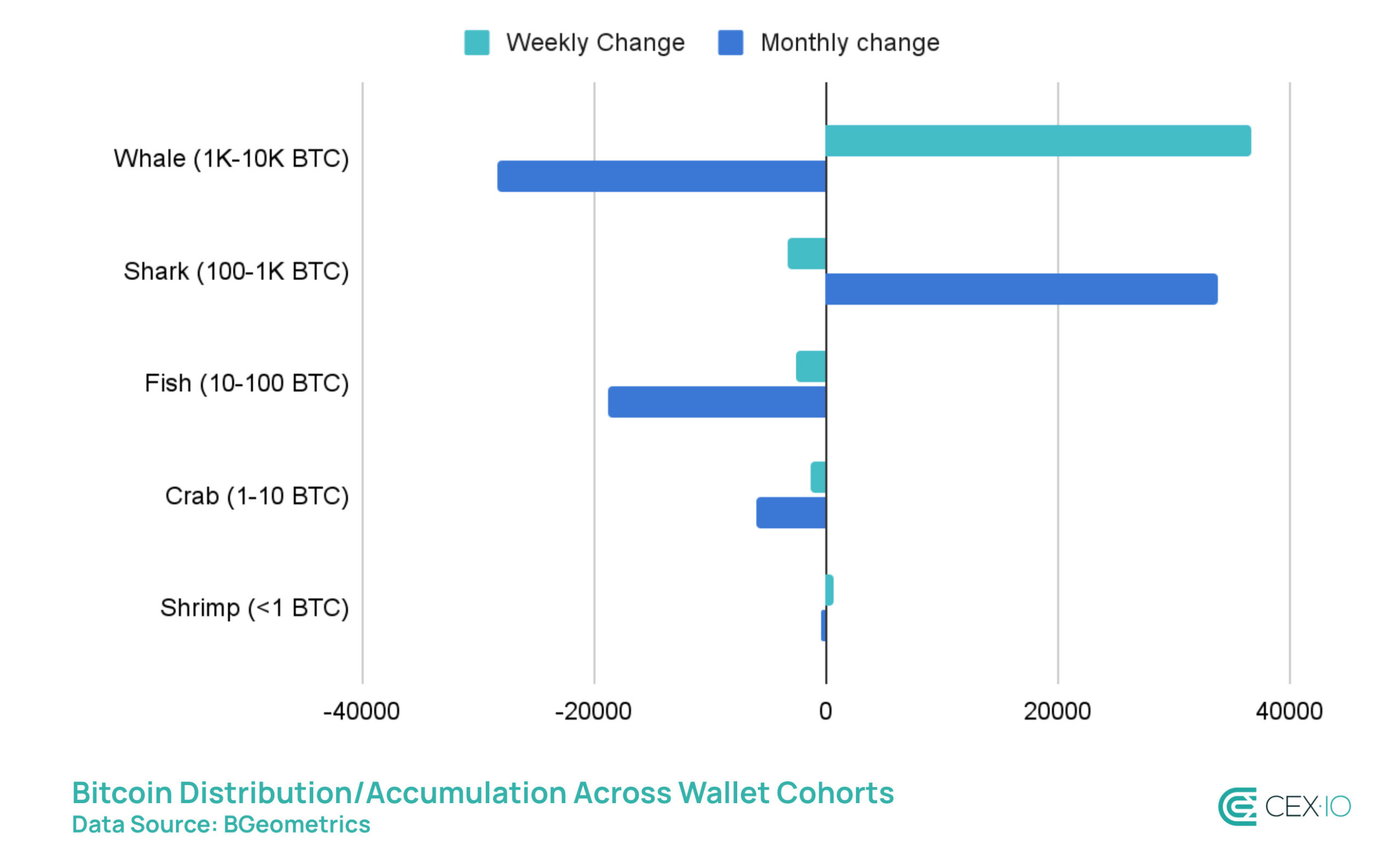
On a positive note, whales, or wallets holding 1K-10K BTC, showed increased Bitcoin accumulation over the past week, acquiring more than 35,000 BTC. If the current trend remains, this can support a potential Bitcoin recovery.
The web content provided by CEX.IO is for educational purposes only. The information and tools provided neither are, nor should be construed as, an offer, or a solicitation of an offer, or a recommendation, to buy, sell or hold any digital asset or to open a particular account or engage in any specific investment strategy. Digital asset markets are highly volatile and can lead to loss of funds.
The availability of the products, features, and services on the CEX.IO platform is subject to jurisdictional limitations. To understand what products and services are available in your region, please see our list of supported countries and territories. This page includes additional links to information about individual products, and their accessibility.