
Signal of the week: Over 30% of Bitcoin held by long-term holders is now sitting at a loss — the highest share since 2023. The move resembles mid-2018 and mid-2022 behavior that preceded a double-digit drop within weeks.
After two weeks of easing, stress returned hard this week — and it came from every direction at once. Institutional money pulled back, fresh buying capital vanished, and the holders who had finally returned to profit last week are selling at a loss again. The market is back in territory that, earlier this year, preceded some of its worst weeks.
About the Bitcoin Impact Index
The Bitcoin Impact Index measures which groups of Bitcoin holders are under financial stress, how severe that stress is, and whether it’s severe enough to shake confidence in the market’s direction. It combines on-chain holder behaviour, ETF and derivatives activity, and exchange-level liquidity flows into a single weekly score between 0 and 100. Unlike sentiment indicators, it deliberately excludes social media and volume data to focus on what participants are doing rather than what they are saying.
Score bands:
- Normal Rotation (0–24) — routine profit-taking, no structural shift
- Elevated Repositioning (25–49) — specific groups shifting positions, pressure uneven across the market
- High Impact (50–74) — broad stress across multiple holder groups and institutional flows simultaneously
- Critical Impact (75–100) — full capitulation: LTH losses, large ETF outflows, major liquidations, and heavy exchange inflows at once
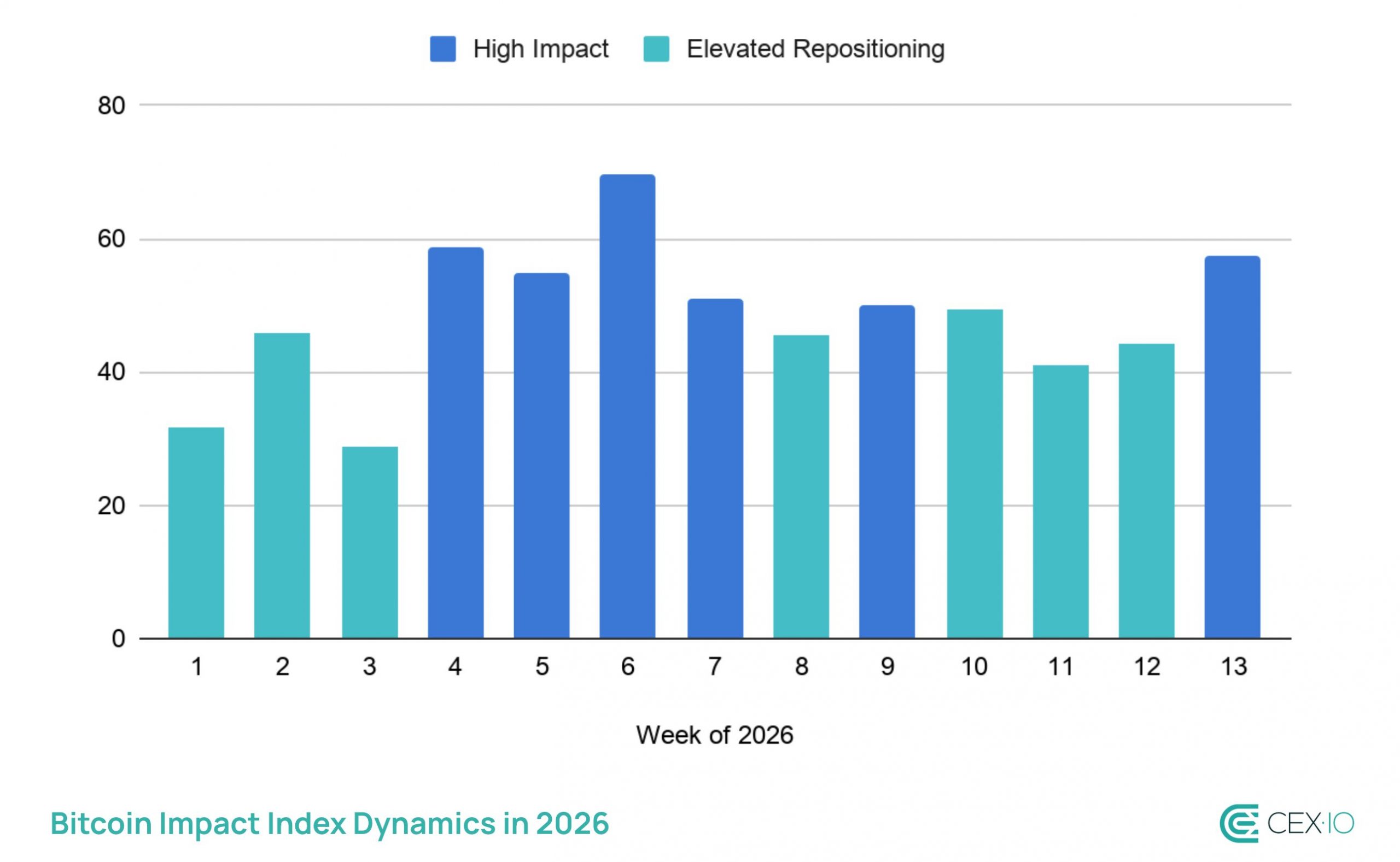
Week 13 (March 22–28): BII 57.4 — High Impact
The index jumped 13 points in a single week, the sharpest rise since late January. Here is what the data shows.
Negative signal: The holders who just recovered are underwater again
Long-term holders started the week selling at a profit for the first time since January. But by the end of the week, SOPR fell to 0.724, wiping out six weeks of recovery. This means long-term holders are now selling at their deepest losses in three years, and the speed of the reversal indicates a sharp deterioration in confidence.
The broader context makes this more concerning. Bitcoin’s price has been drifting slightly higher over recent weeks, but the share of long-term holders sitting in profit has been quietly shrinking at the same time. As for now, more than 4.6 million Bitcoin owned by long-term holders, or over 30% of what they hold, is sitting in a loss, which is the highest share since 2023.
This kind of divergence between price action and on-chain conviction has historically been a warning sign. For instance, similar moves occurred in mid-2018 and mid-2022 before price drops by over 25%.
Short-term holders are not faring better, with their realized P/L falling to lowest level since late January. Overall, nearly half of all Bitcoin in existence (47%) is now sitting at a loss. That matches the levels seen during the most stressed weeks of February.
Negative signal: Liquidity flows reversed
One of the bright spots from previous weeks was a surge of fresh capital flowing into exchanges, ready to buy. But last week, almost all of it reversed. Stablecoin netflows swung from strongly positive (+$250 million daily average) to their most negative reading in months (-$292 million daily average). ETF inflows also turned to outflows, while miners, who had been holding for three weeks, started selling again.
One of the few metrics in the index that did not get worse is the amount of Bitcoin moving toward exchanges to sell — that stayed low, at around 20,900 BTC daily average. Holders are stressed, but they are not panicking yet.
Mixed signal: Derivatives calmed down — but not in a good way
Funding rates moved closer to neutral last week, which sounds like an improvement. However, total liquidations nearly tripled to $288M, with long positions making up 61% of those. When funding rates normalize through long liquidations rather than short covering, it is a sign of forced de-risking rather than improving sentiment.
Whale wallets added marginally, and shark wallets held flat — large holders are not panicking, but they are not adding meaningfully either.
What could happen next
The setup resembles late January, just before the market dropped by more than 30%, to $60,000. Back then, the same combination appeared: both holder groups selling at a loss, institutional money pulling back, and stablecoins draining rather than arriving. What followed was the most stressed period of 2026 so far.
The difference this time is that holders are not yet rushing Bitcoin to exchanges to sell. That kept February’s worst moments from becoming even worse, and it is doing the same now. If that restraint holds, the current stress could stabilize rather than escalate.
But if the price continues drifting lower, the pressure will keep building until the support level breaks, and this could cause a repeat of the selloff two months ago.
The web content provided by CEX.IO is for educational purposes only. The information and tools provided neither are, nor should be construed as, an offer, or a solicitation of an offer, or a recommendation, to buy, sell or hold any digital asset or to open a particular account or engage in any specific investment strategy. Digital asset markets are highly volatile and can lead to loss of funds.
The availability of the products, features, and services on the CEX.IO platform is subject to jurisdictional limitations. To understand what products and services are available in your region, please see our list of supported countries and territories. This page includes additional links to information about individual products, and their accessibility.